
How HR Software Is Transforming Employee Management for Modern Businesses
Managing a workforce has never been more complex. The shift toward remote and hybrid working, rising employee expectations, and the growing demand for data-driven decision-making have all put pressure on HR teams to do more — often with the same resources as before.
Traditional HR approaches built around spreadsheets, paper trails, and disconnected systems are struggling to keep pace. Tracking employee information, managing performance reviews, processing payroll, and maintaining clear communication across a distributed team are all significantly harder when the tools do not work together.
HR software changes that equation. By bringing every core HR function into a single, connected platform, it gives businesses the clarity and control they need to manage their people effectively — regardless of where those people happen to be working.
This guide explains what HR software actually does, how it is changing the way organisations manage their workforce, and what to consider when choosing the right solution for your business.
What Is HR Software?
HR software is a digital platform designed to centralise and streamline the full range of processes involved in managing a workforce. Rather than maintaining separate systems for recruitment, payroll, attendance, and performance — and manually transferring data between them — HR software consolidates everything into one accessible environment.
Depending on the solution, an HR platform may handle any combination of the following:
- Employee data management and record keeping
- Recruitment and applicant tracking
- Employee onboarding workflows
- Attendance and time tracking
- Leave and absence management
- Payroll processing and integration
- Performance management and goal setting
- Employee engagement tools
- Benefits administration
- Workforce analytics and reporting
- Learning and development programmes
The result is a significant reduction in the administrative burden on HR professionals, who can redirect their time toward more strategic, people-focused work.
How HR Software Is Changing Employee Management
Modern HR platforms are reshaping how organisations handle their workforce across four core dimensions: centralisation, automation, employee self-service, and data analytics. Together, these capabilities transform HR from a reactive administrative function into a proactive strategic one.
Centralising Employee Information
In organisations that rely on legacy processes, employee information is typically scattered. Personal records live in one place, attendance data in another, performance reviews somewhere else, and employment history in email threads or physical files. This fragmentation slows down every HR process and increases the likelihood of errors.
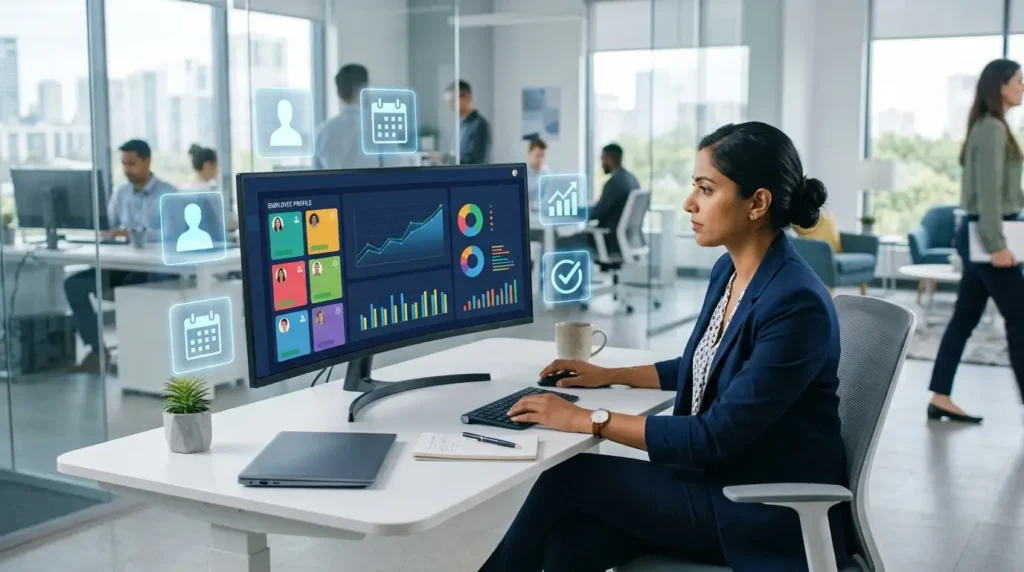
HR software solves this by creating a single, authoritative source of information for each employee — covering their profile, contact details, employment history, position, attendance record, qualifications, and more. When everything lives in one place, retrieving accurate information takes seconds rather than minutes, and the risk of working with outdated data drops significantly.
Automating Routine HR Tasks
A large proportion of day-to-day HR work is repetitive and process-driven. Filing leave requests, sending onboarding documentation, updating employee records, generating standard reports — these tasks consume considerable time when handled manually, and they are also prone to human error.
HR platforms automate these workflows through pre-configured rules and triggers. When an employee submits a leave request through the system, the relevant manager receives an automatic notification and can approve or decline it directly. When a new hire joins, the onboarding checklist activates automatically and routes the right documents to the right people without anyone needing to chase.
The time saved adds up quickly, and it is time that HR teams can spend on work that actually requires human judgment — employee development, culture building, and workforce planning.
Improving Employee Onboarding
First impressions matter. A disorganised onboarding experience — delayed paperwork, missing system access, unclear expectations — signals to a new hire that the organisation is not quite ready for them. That impression is hard to reverse and can directly affect retention.
HR software creates a structured onboarding workflow that automatically sequences every step of the process. New employees can complete their documentation, review company policies, access training materials, and understand what their first weeks will look like — all through a single portal, before they have even walked through the door.
HR managers, meanwhile, get a real-time view of where each new hire is in the process and can intervene immediately if a task is overdue or a step has been missed.
Enhancing Employee Performance Management
Performance management has evolved considerably. Annual appraisals alone are no longer considered sufficient for developing employees or identifying issues early. Modern organisations expect ongoing conversations between managers and their teams — regular goal-setting, continuous feedback, and clear visibility into progress throughout the year.
HR software makes this kind of continuous performance management practical at scale.
Setting and Tracking Employee Goals
Within an HR platform, managers can set goals at the individual, team, or organisational level and monitor progress against them in real time. Employees can update their own progress, flag blockers, and request support — while managers maintain a clear view of where each person stands and where additional guidance might be needed.
This creates a much more transparent and dynamic approach to performance than the traditional annual review cycle, and it gives both managers and employees the information they need to have more productive conversations throughout the year.
Supporting Continuous Feedback
Rather than reserving feedback for scheduled reviews, HR platforms enable managers to log observations, recognise achievements, and document development conversations as they happen. Over time, this builds a rich, accurate picture of each employee’s performance that is far more useful than a single annual snapshot.
Some platforms also allow peer feedback and structured check-ins, which further broaden the data available when performance decisions need to be made.
Empowering Employees Through Self-Service
One of the most significant changes that HR software introduces is the shift from HR-as-gatekeeper to employee self-service. Traditionally, employees needed to contact the HR department for a wide range of routine tasks — requesting documents, checking their leave balance, updating personal information. Each of these interactions consumed time on both sides.
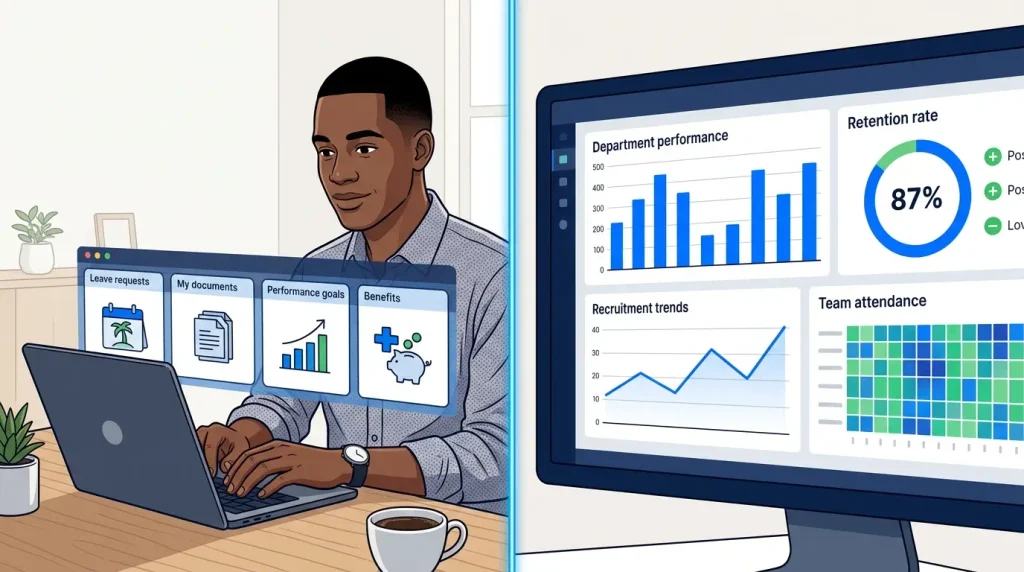
Self-service functionality gives employees direct access to their own HR data and the ability to take action without going through an intermediary. Depending on the platform, employees can typically:
- Update personal contact information and emergency details
- Submit and track leave requests
- View their work schedules and shift patterns
- Access and download payslips and employment documentation
- Review their benefits and make changes during open enrolment periods
- Complete required HR documentation and compliance forms
- View their performance goals and track progress
- Access learning and development resources
The result is a better experience for employees, who feel more in control of their working life, and a reduced administrative burden for HR teams, who can focus on higher-value activities.
Using HR Analytics for Better Workforce Decisions
Modern HR platforms do not just store data — they surface it in ways that make it actionable. Workforce analytics transforms raw HR data into the kind of insight that allows organisations to anticipate problems, identify patterns, and make more informed decisions about their people.
Turning Workforce Data into Actionable Insights
Through built-in analytics and reporting dashboards, HR teams can monitor key workforce metrics in real time: staff turnover rates by department or tenure, absenteeism trends, time-to-hire for open positions, training completion rates, and demographic composition of the workforce, among many others.
These insights allow HR to move from reactive problem-solving — dealing with issues after they have escalated — to proactive planning. A spike in turnover within a specific team becomes visible before it becomes a crisis, creating the opportunity to investigate and respond.
Supporting Data-Driven HR Strategy
Decisions made without data tend to reflect the assumptions and intuitions of whoever is making them. That is not always wrong, but it is inconsistent and difficult to justify or replicate. HR analytics gives leadership teams objective evidence to work with when making decisions about hiring, compensation, workforce structure, and employee development.
For example, if analytics reveal that employees who complete a particular onboarding programme have significantly better 12-month retention rates than those who do not, that becomes a clear, evidence-based argument for investing in that programme more broadly.
Improving Communication and Employee Engagement
Employee engagement has become a critical business metric. Disengaged employees cost organisations in productivity, quality, and retention — and the problem is harder to manage when teams are distributed across multiple locations or working on different schedules.
HR software contributes to engagement in several practical ways. Pulse surveys allow organisations to gauge how employees are feeling at regular intervals, rather than waiting for an annual engagement survey whose results arrive months after the moment has passed. Recognition tools let managers and peers acknowledge contributions publicly, reinforcing the behaviours and values the organisation wants to encourage.
Communication features — announcements, policy updates, direct messaging — ensure that employees across all locations receive the same information at the same time, reducing the information asymmetry that often breeds uncertainty and disengagement.
Supporting Remote and Hybrid Workforce Management
The normalisation of remote and hybrid working has created a genuine operational challenge for HR. When employees are spread across different locations, time zones, and working patterns, the management processes that worked well in a single office environment do not always translate.
HR software provides the infrastructure that makes distributed workforce management practical. A central platform means that employee records, attendance data, leave approvals, performance conversations, and onboarding workflows all operate the same way regardless of where an employee is based. Managers have the same visibility into remote employees as they do into those sitting in the office, and employees have the same access to HR tools and support wherever they are working.
Strengthening HR Compliance and Data Security
HR data is among the most sensitive information an organisation holds — personal details, salary records, performance assessments, health information, and more. Managing this data responsibly is not optional; it is a legal and ethical obligation.
HR software helps organisations meet their compliance obligations by maintaining consistent documentation practices, enforcing appropriate access controls, creating auditable records of HR decisions, and supporting the data retention and deletion policies required by regulations such as GDPR.
Automated record-keeping also makes it significantly easier to produce the documentation required during regulatory audits or employment disputes. Rather than searching through filing systems and email archives, the relevant records can be retrieved quickly from a single, structured system.
It is worth noting that HR software is a tool that supports compliance — it does not replace the need for legal advice or careful policy design. Organisations should ensure their HR system is configured in line with the specific employment laws applicable to their jurisdiction.
The Role of AI in Modern HR Software
Artificial intelligence is increasingly embedded in enterprise HR platforms, and its influence on the day-to-day function of HR is growing. AI-powered features are already being used for resume screening and candidate ranking, intelligent HR chatbots that answer employee queries, predictive workforce analytics, personalised learning recommendations, and the automation of complex administrative processes.
The potential of AI in HR is substantial. The ability to process large volumes of workforce data quickly, identify patterns that would not be visible to a human analyst, and surface recommendations based on those patterns can genuinely improve the quality of HR decision-making.
That said, AI in HR also carries real risks that organisations need to manage carefully. Algorithmic bias in recruitment tools is a documented problem. Automated performance assessments can introduce unfairness if not properly calibrated. Any use of AI that directly affects employment decisions — hiring, promotion, disciplinary action — should be subject to human review and clear accountability structures.
Choosing the Right HR Software for Your Business
There is no single HR platform that is right for every organisation. The best choice depends on the size and complexity of your workforce, your industry and the regulatory environment you operate in, your existing technology stack, your budget, and the specific HR challenges you are trying to solve.
Before evaluating specific platforms, it is worth clarifying your priorities. The following factors are worth assessing for any solution under consideration:
- Core functionality — does it cover the HR processes most important to your organisation?
- Ease of use — will HR teams and employees actually adopt it without significant training?
- Employee self-service capabilities — what can employees manage for themselves?
- Automation — which routine tasks can it eliminate?
- Reporting and analytics — how strong are its data and insight capabilities?
- Integrations — does it connect with your existing payroll, finance, or productivity tools?
- Security and data protection — how does it handle sensitive employee data?
- Scalability — can it grow with your organisation?
- Mobile access — can employees and managers use it effectively on a mobile device?
- Vendor support — what kind of implementation and ongoing support is available?
Taking the time to define your requirements clearly before engaging with vendors will make the evaluation process significantly more straightforward and reduce the risk of investing in a platform that does not fit your actual needs.
The Future of Employee Management
HR software has moved well beyond its origins as an administrative tool. Today’s platforms are genuinely strategic assets — systems that give HR teams the data, automation, and infrastructure they need to manage the complete employee lifecycle, from the moment a candidate applies to the day they leave the organisation.
As automation, AI, workforce analytics, and employee self-service continue to develop, the gap between organisations that invest in modern HR infrastructure and those that do not will widen. The administrative burden that currently consumes a significant proportion of HR capacity will diminish, freeing teams to focus on what actually moves the needle: developing talent, building culture, and creating the conditions in which people do their best work.
Organisations that integrate strong HR technology with thoughtful, human-centred management practices will be meaningfully better positioned to attract, retain, and develop the people they need to grow.
Conclusion
The case for HR software is not simply about efficiency, though the efficiency gains are real and significant. It is about giving organisations the foundation they need to manage their most important asset — their people — with the same rigour and data quality that they bring to financial management, operations, and customer experience.
Data centralisation, process automation, employee self-service, continuous performance management, and workforce analytics are not optional extras for forward-thinking organisations. They are the baseline infrastructure of effective people management in 2026.
HR software makes that infrastructure accessible — and for businesses serious about building a workforce that performs, it is a logical and increasingly necessary investment.
Frequently Asked Questions
What is HR software used for?
HR software is used to manage the full range of workforce processes — from recruitment and onboarding through to payroll, attendance tracking, performance management, and workforce analytics. Rather than maintaining separate systems for each of these functions, an HR platform consolidates them into a single environment, reducing administrative overhead and improving data accuracy.
How does HR software improve employee management?
HR software improves employee management by automating routine administrative tasks, creating a single source of accurate employee data, enabling continuous performance conversations, giving employees self-service access to their own HR information, and surfacing workforce analytics that support better decision-making. The net effect is a more efficient HR function and a better experience for employees.
Can HR software support remote and hybrid employees?
Yes — this is one of the clearest use cases for modern HR platforms. Because everything runs through a central digital system, employees can access HR tools and information regardless of where they are working, and managers have consistent visibility across their entire team whether it is co-located or distributed across multiple locations.