

What Practices Are Beneficial for Training AI Models With Prompts?
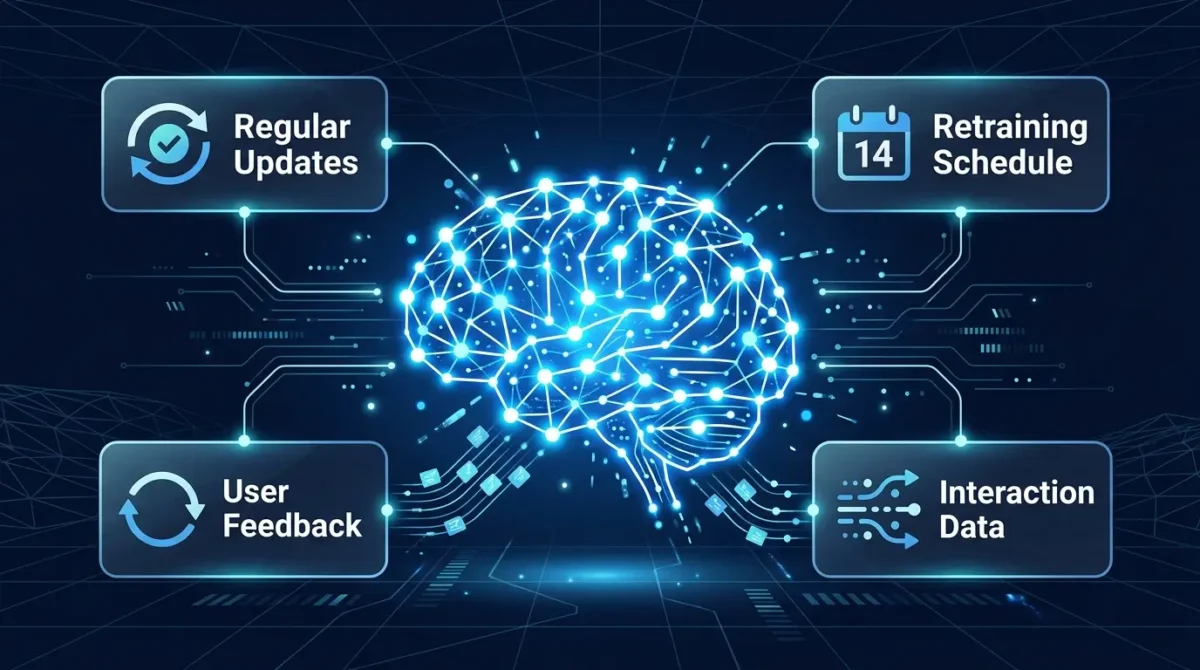
If you have come across this question — whether in a course, a certification exam, or real-world AI development — the short answer is this: regular updates, scheduled retraining, and the use of real user interaction data are all beneficial practices for training AI models with prompts. Ignoring feedback is not.
But that four-word answer only scratches the surface of what actually makes prompt-based AI training effective. Understanding why these practices work — and what separates a well-trained model from one that drifts, hallucinates, or underperforms — is what this guide is about.
We will start with the exam-level answer, then go much deeper into the practical techniques that AI news and analysis researchers and developers are using to build more reliable AI systems in 2026.
The Quick Answer: What Practices Are Beneficial?
Before diving into the full explanation, here is the direct answer to the question as it typically appears in AI courses and assessments:
The practices that are beneficial for training AI models with prompts are:
✅ Regular updates — keeping training data and model configurations current as the world changes
✅ Schedules for retraining — establishing a systematic cycle for refreshing the model rather than leaving it to stagnate
✅ Utilizing user interaction data — learning from real usage patterns to improve relevance and accuracy
❌ Ignoring feedback — this is the incorrect answer and the one practice that actively harms model quality
The table below summarises this at a glance:
| Practice | Beneficial? | Why |
|---|---|---|
| Regular updates | ✅ Yes | Keeps model relevant as data evolves |
| Schedules for retraining | ✅ Yes | Prevents performance drift over time |
| Ignoring feedback | ❌ No | Removes the signal needed to improve |
| Utilizing user interaction data | ✅ Yes | Grounds the model in real usage patterns |
Now let us understand what each of these actually means in practice — and why they matter so much.
Understanding the Difference: Training Prompts vs Inference Prompts
Before going further, one distinction is essential and frequently misunderstood. There are two very different ways that prompts interact with AI models, and confusing them leads to unclear thinking about training practices.
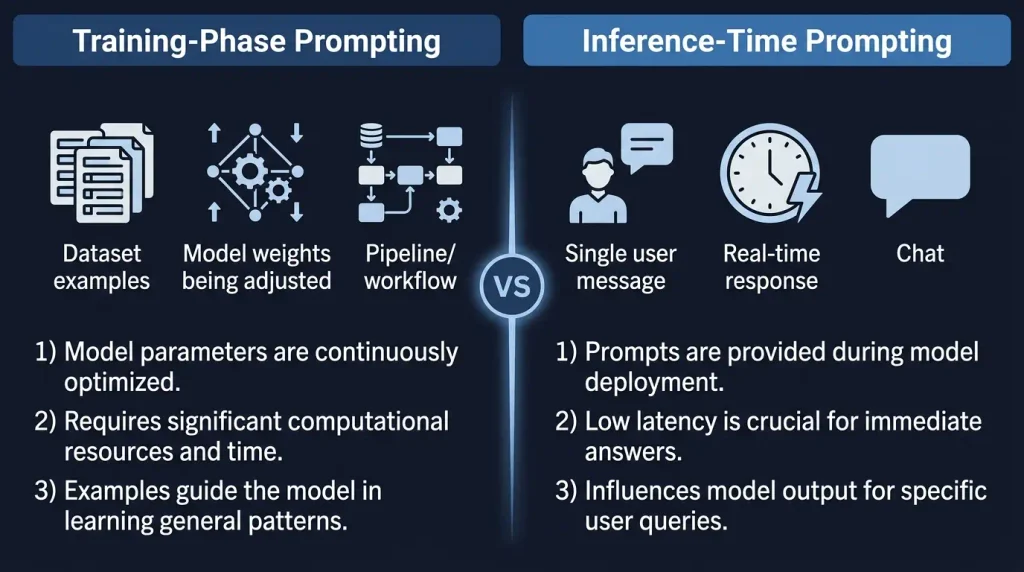
Inference-time prompting is what most people mean when they talk about prompt engineering in everyday conversation. It is the process of writing better instructions to get better outputs from an already-trained model — the queries you type into ChatGPT, Claude, or Gemini. The model’s weights do not change. You are just working with what the model already knows.
Training-phase prompting is something fundamentally different. Here, prompts are part of the training data itself. They define what the model learns — what kinds of inputs it should expect, what kind of reasoning it should apply, and what form its outputs should take. When you train a model with prompts, you are shaping its internal behaviour, not just guiding its existing behaviour.
The practices we are discussing in this article operate at the training-phase level. They determine how well the model learns, how accurately it generalises, and how long it stays useful before needing to be refreshed.
The 4 Core Practices — Explained in Full
1. Regular Updates
AI models are trained on data collected up to a certain point in time. The world does not stop changing once that cutoff passes — new terminology emerges, user needs shift, products are updated, and entire categories of questions that did not exist six months ago become common. A model trained on last year’s data and left unchanged will answer this year’s questions with yesterday’s knowledge.
Regular updates address this by refreshing the training data that informs the model’s understanding of its domain. This does not always require full retraining from scratch. In many cases, targeted updates to specific knowledge areas — supplemented by retrieval-augmented generation (RAG) or prompt injection of recent information — can keep a model current without the full cost of retraining.
The practical outcome of regular updates is that the model stays relevant. Its answers reflect the current state of the domain rather than a snapshot that grows increasingly outdated with time.
What this looks like in practice: A customer service AI trained on product documentation needs those documents updated whenever products change. A medical information assistant needs its clinical data refreshed as guidelines evolve. An AI writing tool needs its style and terminology guidance updated as language conventions shift.
2. Schedules for Retraining
Regular updates and retraining schedules are related but distinct. Where updates might patch specific knowledge gaps, scheduled retraining is a more comprehensive process — periodically rebuilding or significantly refreshing the model on a revised and expanded dataset.
Without a retraining schedule, models tend to drift. Performance degrades gradually as the gap between training data and real-world conditions widens. The model becomes more likely to produce outdated information, fail on edge cases it previously handled, or misalign with user expectations that have evolved since training.
Establishing a retraining schedule creates a predictable maintenance cycle — similar to the way software applications receive regular updates rather than being released once and left unchanged. The appropriate cadence depends on how rapidly the model’s domain changes and how critical accuracy is for its specific application.
What this looks like in practice: A high-stakes legal research AI might retrain quarterly to incorporate new case law and regulatory changes. A general-purpose writing assistant might retrain annually. A news summarisation tool might need monthly refresh cycles. The schedule should be driven by domain velocity, not by convenience.
3. Utilizing User Interaction Data
User interaction data — the actual inputs, queries, and feedback generated by real users interacting with a deployed model — is among the most valuable training signals available. It tells you what real people actually ask, how they phrase their questions, where the model fails to satisfy them, and which edge cases appear repeatedly in the wild.
This is significantly more informative than synthetic training data generated before the model is deployed. Synthetic data can prepare a model for expected scenarios. User interaction data prepares it for reality — including all the unexpected, poorly-phrased, ambiguous, and highly specific queries that real usage generates.
Importantly, user interaction data used for training must be handled responsibly. Privacy protections, anonymisation, and informed consent are not optional considerations — they are legal and ethical requirements in most jurisdictions, and they are particularly important in consumer-facing AI applications.
What this looks like in practice: A deployed chatbot logs conversations where users expressed dissatisfaction or rephrased their question multiple times — signalling that the model’s initial response was insufficient. These interactions are reviewed, cleaned, and used to create better training examples that improve performance on those specific failure patterns.
4. Incorporating Feedback (Not Ignoring It)
The fourth practice in the original question — ignoring feedback — is explicitly the wrong answer, which makes understanding the right approach here especially important.
Feedback, in AI training, comes in multiple forms: explicit ratings from users (thumbs up / thumbs down), implicit signals from user behaviour (did they rephrase and try again?), expert annotations from human reviewers, and systematic evaluation against held-out test sets.
All of these are training signals. Reinforcement Learning from Human Feedback (RLHF) — the technique behind the alignment improvements in models like GPT-4, Claude, and Gemini — is built entirely around incorporating human feedback into the training process. Models trained with RLHF are significantly more aligned with human preferences than those trained on raw data alone.
Ignoring feedback means ignoring the signal that tells you where the model is wrong, biased, or unhelpful. A model trained without feedback loops will accumulate errors that could have been caught and corrected, and will continue producing outputs that fail users in known, documented ways — because no one used the failure data to improve it.
8 Advanced Practices for Training AI Models With Prompts
Beyond the four core practices above, researchers and AI engineers working on production systems in 2026 use a broader set of prompt-based training techniques. These go deeper than the exam-level answer and reflect how serious AI development actually works.
5. Few-Shot Formatting in Training Data
Few-shot learning provides the model with examples of the input-output pattern you want it to learn. Rather than training on raw examples and hoping the model infers the correct format, you embed structured examples directly in the training prompts.
Each example shows the model: here is what a good input looks like, here is the reasoning process, here is the correct output. Repeating this pattern across thousands of training examples teaches the model to apply the same structure when it encounters new inputs.
The key is quality over quantity. A smaller set of high-quality, diverse, correctly-formatted few-shot examples will produce better results than a large set of inconsistent or ambiguous ones.
6. Chain-of-Thought Prompting in Target Responses
Chain-of-thought (CoT) prompting — embedding step-by-step reasoning in the target responses within training data — is one of the most impactful advances in prompt-based model training of recent years.
When a model is trained on data that includes explicit reasoning steps before arriving at an answer, it learns to reason rather than simply pattern-match. The result is significantly better performance on complex tasks that require logic, multi-step calculation, or nuanced judgment.
For training purposes, this means constructing training examples where the desired output is not just the correct answer, but the correct answer accompanied by the reasoning path that leads to it.
7. Diverse Prompt Phrasing Across Training Data
A model trained on prompts that all look similar will become brittle — performing well when inputs match the training distribution and poorly when they do not. Real users phrase the same question in dozens of different ways.
Training on diverse prompt formulations — different phrasings, different levels of specificity, different tones, different formats — builds a model that generalises rather than memorises. The goal is to expose the model to the full range of variation it will encounter in deployment, not just the most common form.
8. Explicit Constraint Embedding
Advanced training prompts increasingly embed explicit constraints into both the prompt structure and the expected outputs. Rather than asking the model to “figure out the best answer,” well-crafted training prompts specify what the model should and should not do, what format the output should take, and what quality standards apply.
This technique produces more predictable, auditable model behaviour in production — particularly important in enterprise and regulated-industry applications where consistency is a compliance requirement, not just a nice-to-have.
9. Prompt Variation and Stress Testing
Before finalising training data, effective practitioners test their prompt structures against edge cases, adversarial inputs, and borderline scenarios. Prompts that produce correct outputs on clean inputs but fail on messy or ambiguous ones expose the model to a skewed view of the world.
Including stress-tested prompt variations in training data ensures the model learns from the difficult cases, not just the easy ones — resulting in significantly better real-world performance.
10. Human Review Before Training Inclusion
Not all generated training examples are equal. A human review step — before prompt-response pairs are included in the training dataset — catches errors, removes bias, and ensures quality standards are maintained across the dataset.
This is time-consuming but important. Training data quality directly determines model quality. The phrase “garbage in, garbage out” is as true for prompt-based AI training as it is for any other data-dependent system. This is closely related to AI alignment and safety concerns that researchers increasingly flag as frontier AI systems become more capable.
11. Separation of Training and Evaluation Prompts
A model evaluated on the same prompts it was trained on will appear to perform better than it actually does — it has, in effect, memorised the test rather than learned the skill.
Effective prompt-based training maintains a strict separation between the prompts used in training and those used in evaluation. The evaluation set should reflect real deployment conditions, not the training distribution, so that performance metrics accurately reflect generalisation rather than memorisation.
12. Version Control for Prompt Datasets
As training datasets evolve — with new examples added, old ones revised, and feedback incorporated — maintaining version control becomes essential. Knowing exactly which version of a prompt dataset produced a specific model version allows teams to trace performance changes, identify regressions, and roll back if a dataset update causes unexpected behaviour.
This is a workflow consideration rather than a prompting technique, but it is one that separates ad-hoc AI development from systematic, maintainable AI engineering.
Why Ignoring Feedback Is the Wrong Answer
The question specifically includes “ignoring feedback” as one of the four options — and it is the only incorrect one. It is worth understanding why this is the case so clearly.
AI models do not improve through exposure to data alone. They improve through a cycle of generation, evaluation, and correction. Feedback is what makes correction possible. Without it, the model has no mechanism to identify and fix its own errors.
The most important training methodologies in modern AI development — RLHF, constitutional AI, direct preference optimisation — are all built on this principle. How AI-generated images are detected through detection tools is itself a product of models trained with continuous feedback on what constitutes real versus synthetic imagery.
Incorporating feedback is not just beneficial — it is foundational to how modern AI models reach the level of capability and alignment that makes them useful in real applications.
Prompt-Based Training vs Fine-Tuning: What Is the Difference?
A related question that often comes up alongside training practices is how prompt-based training relates to fine-tuning. They are not the same thing, and understanding the distinction matters for choosing the right approach.
Prompt-based training works by structuring the training data that a model learns from — using carefully designed prompts to shape the model’s input-output behaviour without necessarily changing its core parameters significantly. Techniques like prompt tuning optimise soft prompt vectors during training while keeping most of the model’s weights frozen.
Fine-tuning involves updating the model’s underlying parameters directly on a new dataset. It is more computationally intensive, requires more data to be effective, and carries a higher risk of catastrophic forgetting — where the model loses generalised capability as it over-specialises on the fine-tuning dataset.
For many practical applications, especially those with limited data or compute budgets, prompt-based training methods offer a more efficient path to improved model behaviour. They can be applied iteratively, rolled back if they cause regressions, and validated before full deployment.
The AI tools used in everyday workflows increasingly reflect this architecture — models guided by structured prompt systems rather than fully retrained on every new task.
A Practical Checklist for Training AI Models With Prompts
Before committing to a training approach, use this checklist:
Data quality: → Are your training prompts diverse in phrasing and format? → Have human reviewers validated the prompt-response pairs? → Are edge cases and borderline inputs represented? → Is there a clear separation between training and evaluation sets?
Feedback incorporation: → Is there a mechanism to collect user feedback post-deployment? → Is that feedback being systematically reviewed and used? → Are failure cases being converted into new training examples?
Maintenance: → Is there a defined retraining schedule aligned with domain velocity? → Is version control in place for prompt datasets? → Are updates to training data documented and traceable?
Evaluation: → Are evaluation prompts representative of real deployment conditions? → Is performance being tracked against consistent benchmarks? → Is there a defined process for investigating performance regressions?

Frequently Asked Questions
What practices are beneficial for training AI models with prompts?
The beneficial practices are regular updates to keep training data current, scheduled retraining to prevent performance drift, and the use of real user interaction data to ground the model in actual usage patterns. Incorporating feedback — not ignoring it — is also essential. Reinforcement Learning from Human Feedback (RLHF), few-shot formatting, chain-of-thought target responses, and diverse prompt phrasing are additional practices used in production AI systems.
Why is ignoring feedback not a beneficial practice for training AI?
Feedback is the signal that tells a model where it is wrong, biased, or unhelpful. Without it, errors accumulate uncorrected and the model has no mechanism to improve on its known failure cases. All major AI alignment and improvement methodologies — including RLHF — are built on the systematic incorporation of feedback rather than the absence of it.
What is the difference between training-phase prompting and inference-time prompting?
Inference-time prompting is writing better instructions to get better outputs from an already-trained model — the model’s weights do not change. Training-phase prompting uses prompts as part of the training data itself, shaping what the model learns rather than just guiding its existing behaviour.
How often should an AI model be retrained?
The appropriate retraining cadence depends on how rapidly the model’s domain changes and how critical accuracy is. High-stakes applications in rapidly-changing domains — legal, medical, financial — may require quarterly retraining. General-purpose models in stable domains might retrain annually. The schedule should be driven by observed performance drift and domain velocity, not arbitrary time intervals.
What is user interaction data in AI training?
User interaction data refers to the actual inputs, queries, and behavioural signals generated by real users interacting with a deployed model. It includes the questions users ask, the ways they rephrase when unsatisfied, explicit feedback ratings, and implicit signals like session abandonment. This data is particularly valuable for training because it reflects real-world usage rather than synthetic assumptions about what users will ask.
What is RLHF and why does it matter for AI training?
Reinforcement Learning from Human Feedback (RLHF) is a training methodology in which human evaluators rate model outputs and those ratings are used to train a reward model, which in turn guides further model training toward outputs that humans rate more highly. It is the primary technique behind the alignment improvements in models like GPT-4, Claude, and Gemini, and it is fundamentally built on incorporating feedback rather than ignoring it.
Can prompt-based training replace fine-tuning?
Not entirely — but for many practical applications, prompt-based training methods including prompt tuning offer a more efficient and reversible alternative to full fine-tuning. They require less compute, less data, and carry a lower risk of catastrophic forgetting. The right choice depends on the task, the available resources, and how specialised the model needs to become.
Sources: Anthropic Prompt Engineering Guide (claude.com/blog); K2View Prompt Engineering Techniques 2026; Artjoker AI Prompt Engineering Best Practices 2026; Vegavid AI Training Guide 2026; OpenAI RLHF Research.