
AI Assisted Development in 2026: Technologies, Best Practices, and Top Companies
In 2026, artificial intelligence (AI) is going beyond just completing code. AI is now part of the whole software delivery lifecycle, including refining backlogs, planning software architecture, generating code, testing, documenting, reviewing for security, and supporting production software. Because of this, the way we think about AI has changed. The conversation used to be about whether or not teams are using AI. Now the conversation is about how to incorporate it into their engineering processes while maintaining quality, security, and accountability.
This is important because the maximum value is generated when AI becomes part of a formal delivery process. According to various studies conducted within the industry (both by practitioners and researchers), most success, benefit, and value gained from using AI can be seen in the areas of implementation, testing, and documentation. However, these benefits are fully realized only when companies use a combination of AI and human oversight, governance, and production-level software engineering practices. In short, AI-assisted development has evolved from being experimental to being part of standard operations.
Table of Contents
The technologies shaping AI-assisted development in 2026
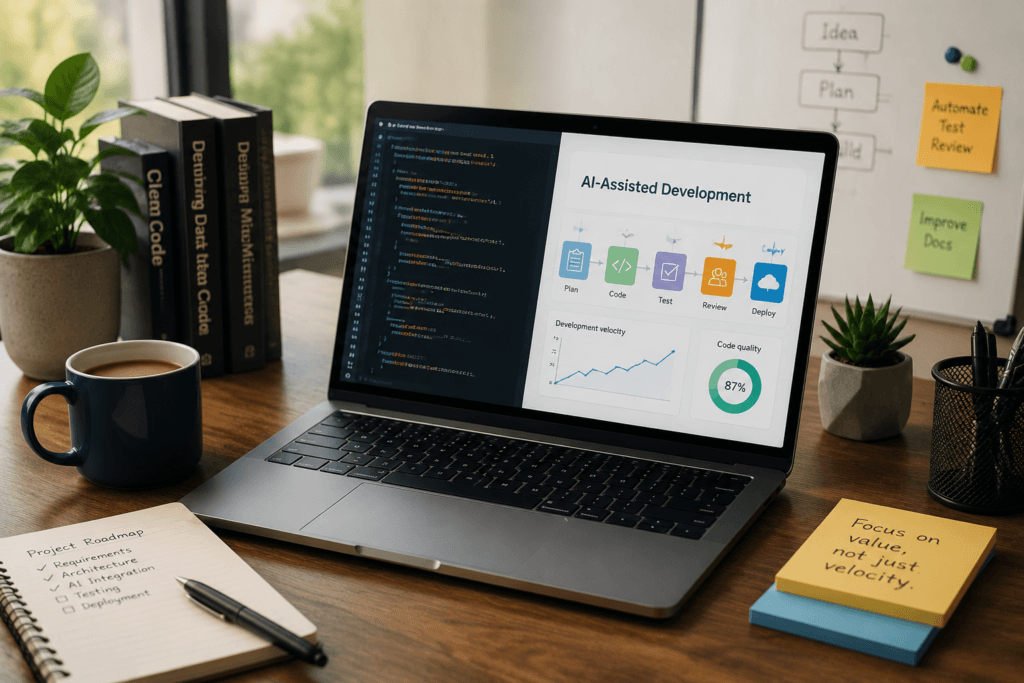
AI-assisted software development is increasingly relying on tools that support agile methods of project completion among the best performers. There are now advanced, emerging technologies within the AI ecosystem that can be integrated with other methodologies in order to deliver projects much more efficiently than before. The amount of change that happened last year was not only in how high-quality models are being created, but also in how AI is moving from pilot projects into business systems as part of an ongoing engineering workflow.
Ultimately, companies that have been the most successful at implementing these technologies are doing so by using many of these industries’ technologies repeatedly across multiple engineering processes. For having an RAG model that references internal process documentation or codebases in conjunction with an automated quality control (QC) or review (RAN) process within a single operation for repetitive engineering tasks, MLOps or LLMOps controlled by enterprise security and compliance to the model access and data handling and audits for training on other previously used models.
Therefore, to properly evaluate a company as an AI development partner, there is more that needs to be considered beyond simply looking for the use of well-known tools; this includes determining whether the company is able to safely and efficiently implement its AI technologies into real-world software delivery processes.
Best practices for AI-assisted development in 2026
In 2026, many leading organizations will employ these best practices for developing with AI assistance, as they are now becoming the norm.
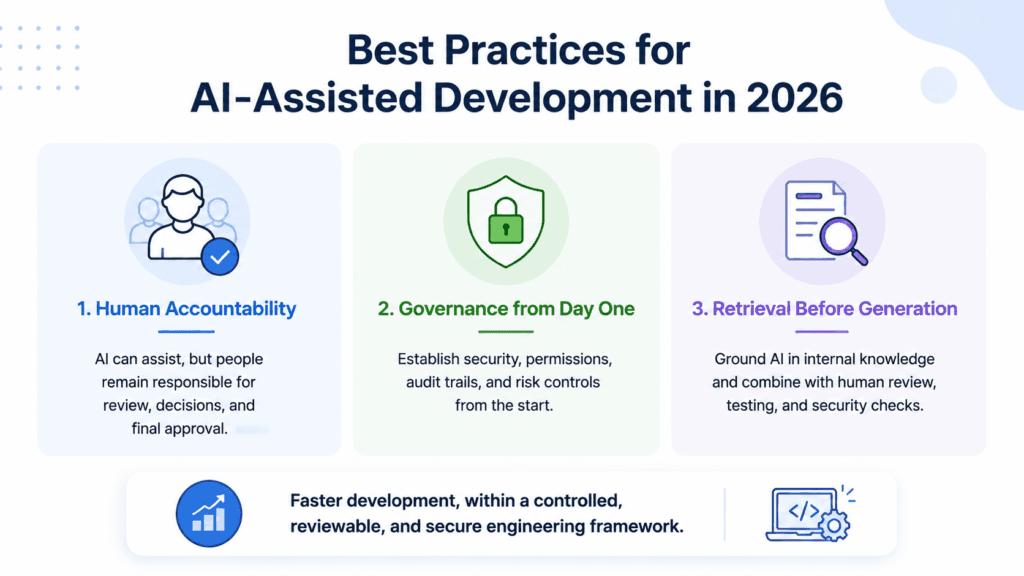
Human accountability
All humans involved in the software lifecycle (coding/testing/documenting) ultimately remain accountable for their actions, regardless of the use of AI as an acceleration mechanism. Development teams tend to confirm that individuals are held accountable to some degree when it comes to reviewing, licensing, making architectural decisions, and providing final approval of the software they have developed (whether by AI or manual means), since AI cannot replace the primary ownership of the software.
Governance from day one
Establish governance from day one, including securing model access; providing role-based access rights; creating audit trails; developing evaluation routines; and establishing acceptable risk controls around sensitive data and tool execution. When established within defined boundaries, AI becomes significantly more useful because poorly defined boundaries may hinder the usefulness of AI, especially within regulated and/or enterprise type environments where traceability of processes is as important as execution speed.
Retrieval before generation
Retrieve information before generating it. In enterprise development, the most reliable AI systems use only internally generated product documentation (e.g., tickets, code repositories, architecture notes, and other organizational knowledge bases) to produce outputs, which helps to alleviate the risks of AI-generated hallucinations and improve output relevance. In addition, using human review, automated tests, and security scanning on top of retrieval-based information creates a significantly higher level of confidence in production results than using AI alone.
These few best practices define good AI-assisted development in 2026, which will yield faster output as well as a controlled, traceable, and secure engineering environment.
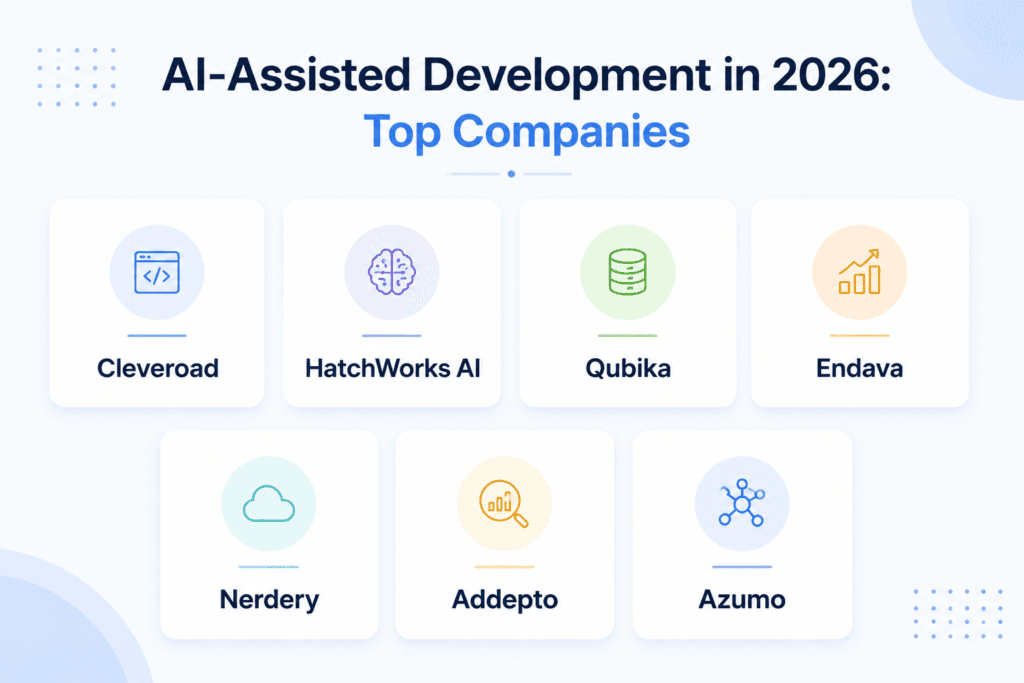
AI-Assisted Development in 2026: Top Companies
The companies below are examples of some to consider as strong contenders for AI-assisted development work in 2026, as determined by publicly available information and the criteria outlined in this article.
- Cleveroad
- HatchWorks AI
- Qubika
- Endava
- Nerdery
- Addepto
- Azumo
To ensure our selection process was as objective and trustworthy as possible, we sought input from AI solution architects and delivery leads who were focused on the practical implementation of software engineering practices related to their area of expertise. The 34 vendors identified as potential options were determined through vendor research on publicly available sources and through company-published files for each vendor. We then narrowed the list of providers by identifying which vendors possessed three distinct features:
- Evidence that they are capable of delivering AI technology solutions (more than just basic AI consulting services)
- Demonstrated track record of industry experience with complex or regulated projects.
- Recognized by official agencies or organizations as meeting quality requirements in security, certifications, etc.
1. Cleveroad
Cleveroad has included AI-assisted development within software delivery models, instead of having a separate experimental line. It combines AI capability with existing production-level engineering, making it a potential vendor for businesses seeking AI integration into their production systems rather than just an isolated proof of concept.
- Technical capabilities: AI consulting, machine learning, generative AI, RAG and knowledge base solutions, custom AI agents, and AI-assisted engineering workshop capabilities supported by web and mobile development, DevOps, quality assurance, and product discovery services
- Industry experience: healthcare, logistics, fintech, multimedia, retail, travel, and education
- Recognition/certification: ISO 9001, ISO 27001, AWS Partnership Designation, and Clutch-based recognition; for the purpose of writing this guest post, they also have 80 Clutch reviews with an average of 4.9/5 stars.
2. HatchWorks AI
HatchWorks AI is one of the more specialized companies on this list in helping organisations deliver AI native products. Its public materials mainly focus on how to build AI native products, automate business workflows, and help enterprises transition from experimenting with AI to implementing AI with measurable business value. In addition to providing public docs, HatchWorks AI also provides several other practical guides, such as RAG documentation, agentic workflows, and AI operating models, and thus indicates that HatchWorks has articulated a structured methodology for adoption.
- Technical Expertise: Developing AI native products, automating business processes, RAG implementation, designing agentic workflows, supporting AI operating model
- Industry Experience: Healthcare, telecommunications, industrial, and enterprise services; public client references are available from Cox, DIRECTV, Stanley Black & Decker, Viasat, and Hinge Health.
- Awards/Affiliations: Named #1 AI Services Company by Clutch; Inc. AI Power Partner.
3. Qubika
Qubika provides AI-enabled development solutions concentrated in areas of data engineering, governance, and platform Delivery. The components of the company’s AI offerings are named frameworks/accelerators that include public reference cases for human-in-the-loop oversight, enterprise agent lifecycle management, and data governance. These solutions may be particularly useful for companies needing to integrate AI into their business systems with a greater degree of control.
- Examples of Qubika’s technical capabilities include: AI-augmented development; enterprise agents; data governance; workflows supporting human-in-the-loop processes; and AI delivery framework examples such as AccelerateAI; Agentic Factory; and QBricks.
- Examples of areas where Qubika has industry experience: financial services, healthcare and life sciences, and high technology.
- Qubika has received awards and recognitions, including recognition from Constellation Research as an AI-exponential consulting firm; an audited NPS of 82 from PwC; a 4.9 Clutch rating (aggregated from 57 reviews); completion of SOC 2 Type 2 audit; completion of ISO 27001 certification; and alignment to NIST AI Risk Management Framework.
4. Endava
The reason that Endava was chosen is that the company has an established way of combining both businesses, with how customers can use AI as part of their transformation and modernisation processes in order to automate intelligent business processes. They do not provide AI as a stand-alone but rather integrate AI into transformational activities with their framework and extensive enterprise delivery capabilities. Therefore, it is intended to be applicable for enterprise-sized organisations that will utilise AI to assist in the development of applications in either a highly regulated or legacy-saturated regulated environment.
- Technical Capabilities: AI-enabled transformation, Intelligent Automation, and Framework-based delivery through their Dava.X and Dava.Flow platforms.
- Industry Experience: Payments, Banking, Healthcare, Insurance, Telecom, Retail, Logistics, Government, and Travel.
- Recognition/Certification: SOC 2 Type II; ISO 9001, ISO 27001, ISO 20000-1, ISO 22301, ISO 14001, ISO 37001, Cyber Essentials; TISAX-related certification/registration.
5. Nerdery
Organizations that are researching AI-assisted development along with digital product engineering, cloud modernization, and analytics transformation would benefit from working with Nerdery. Their website shows a balance of both strategy and implementation services to assist in the development of AI, whether embedded into customer-facing products or internal systems, rather than developing AI as a separate experiment.
- Technical capabilities: AI and machine learning strategy; AI and ML application development; AI agent application development; generative artificial intelligence; MLOps; digital platform engineering; custom software development.
- Industry experience: public sector and enterprise modernization environments.
- Recognitions/certifications: Google Cloud Partner of the Year 2026 for Service & Industry Solutions; awarded three 2026 Google Public Sector Partner Expertise Badges for Data Analytics, Maps & Geospatial, and AI/ML.
6. Addepto
Addepto specializes in AI and primarily focuses on the big data, enterprise AI, and machine learning markets, as opposed to providing general software outsourcing. Addepto offers meaningful assistance to clients building AI-enabled applications that depend on a solid data foundation, cutting-edge analytics, and decision-making based on models.
- Experience: machine learning applications, deep learning, developing data platforms, and developing generative AI
- Industry: AI solutions that are data-intensive or specialized (e.g., specific datasets/requirements to operate) have been implemented in several industries.
- Awards/Certifications: There are publicly available references to the Deloitte Fast 500 list, FT1000, Forbes, Top AI Companies 2024, and Clutch Top BI & Big Data Consultants in LA 2023.
7. Azumo
Azumo has a clear commitment to AI-enabled engineering delivery, as evidenced by its public documentation, which demonstrates both its implementation capacity (how much it can build for customers) and its day-to-day engineering practices (the way in which developers regularly utilize AI to perform their job functions and autonomously inspect code). This high level of detail will matter to customers in 2026 when they are going to be interested in knowing how AI is actually being applied to help them deliver their products, rather than just knowing if an AI exists.
- Technical capabilities: include but are not limited to AI engineers, AI-assisted development, agent-based solutions, RAG, model fine-tuning, computer vision, data engineering, and providing enterprise applications via web, mobile, and cloud as well as voice interfaces.
- Industry experience: can be evidenced through various public references, including companies such as Meta, Omnicom, Twitter, UnitedHealth, and Discovery Channel, with best practices ranging from NLP, predictive ML, semantic search, generative AI, and CV.
- Recognition and certifications have been achieved for SOC 2, as well as a leading position as a provider of AI software development solutions.
Final thoughts
In 2026, the focus of selecting an AI development partner shifts from using tools to give the added productivity gained through converting AI into a repetitive, secure, and production-ready delivery method. Each of these vendors has combined its respective AI and engineering capabilities with established data characteristics, human reviews, quality assessments (QA), and governance. Thus, the companies listed above should be viewed as being credible choices based on delivery needs. Most of the companies are very strong in the areas of enterprise compliance, AI-native products, or data-based transformation.
Frequently Asked Questions
What is AI-assisted development?
AI-assisted development combines artificial intelligence with software engineering to improve coding, testing, debugging, documentation, and deployment.
What are the benefits of AI-assisted development?
It improves productivity, reduces repetitive work, enhances code quality, and accelerates software delivery while maintaining governance and security.
Which industries benefit from AI-assisted development?
Healthcare, fintech, logistics, retail, manufacturing, education, and enterprise software companies are among the leading adopters.
How do I choose an AI development company?
Look for proven technical expertise, industry experience, security certifications, governance practices, and successful project delivery.