

Instagram vs TikTok for U.S. Content Creators in 2026
Instagram vs TikTok for content creators in the US. is no longer just a preference; in 2026, it’s a financial decision. You’ve got a video ready to go, same clip, two apps open on your phone. One tap sends it to Instagram, the other to TikTok. For years, that choice felt like a coin flip. Today, both platforms have matured their monetization programs, refined their algorithms, and built distinctly different audiences, with real income differences attached to each. Choosing wrong doesn’t just cost you views; it costs you money.
This comparison covers what U.S. creators actually need to know: audience demographics, how each algorithm distributes content, real engagement benchmarks, monetization tradeoffs by follower tier, and a concrete 30-90 day framework for testing your choice. By the end, you’ll have a clear answer on which platform fits your niche and the numbers to back it up.
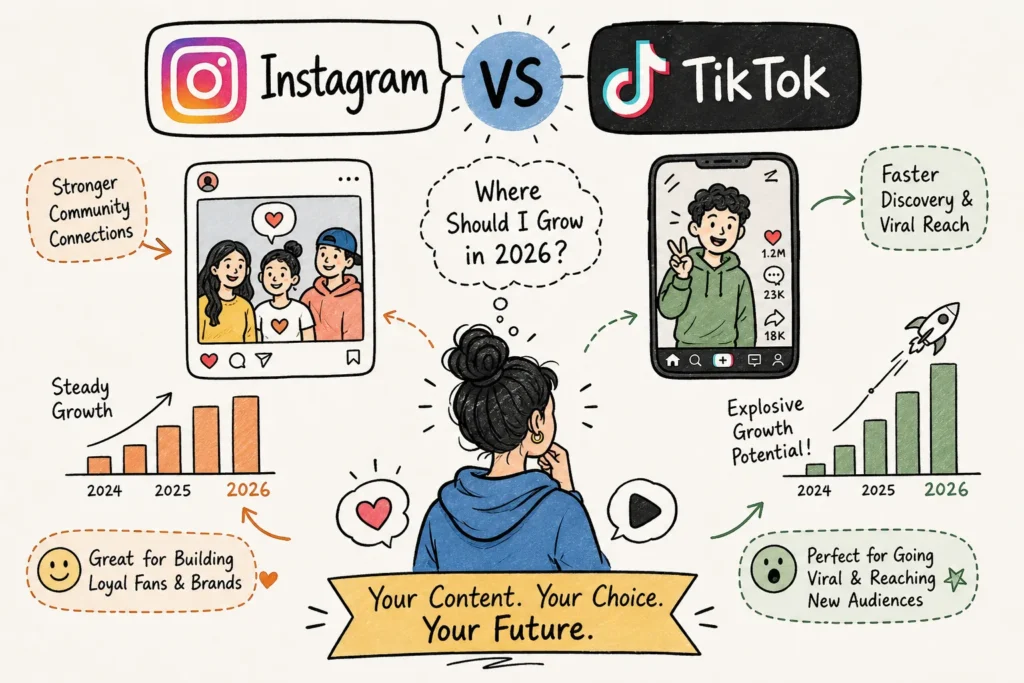
Table of Contents
Who’s actually using each platform in the U.S.
Instagram’s U.S. audience in 2026
Instagram has 171.7 million U.S. users, with 54.8% of them falling in the 18-34 age bracket. Among U.S. adults aged 18-29 specifically, 76% are active on the platform. The user base skews slightly female at 55.4%, and the audience profile leans millennial-to-early-Gen-Z with stronger brand familiarity and higher purchase intent than TikTok’s core base. Instagram statistics and trends provide deeper breakdowns on age and engagement for 2026.
That purchase intent matters. Instagram users are further along in their buyer journey. They’ve grown up with the platform’s shopping integrations, product tagging, and branded content. For creators working in fashion, beauty, fitness, or any niche tied to a purchase decision, that context translates directly into better affiliate conversion and brand deal ROI.
TikTok’s U.S. audience and what the age gap means for creators
TikTok has 136 million U.S. monthly active users. Its core domestic base is Gen Z: 72% of U.S. Gen Z has a TikTok account, and 63% of all U.S. users are under 30. The average U.S. TikTok user spends 52 minutes per day on the app compared to 33 minutes on Instagram. That 19-minute gap means more scroll time per session, more opportunities for your content to surface, and a longer window for affiliate links and product discovery to work.
The implication for creators is practical. TikTok audiences are more likely to discover you before they know who you are. Instagram audiences are more likely to already know you or someone like you. Those two dynamics produce very different growth curves, especially in the first 90 days of a new account.
How each algorithm actually decides what your content is worth
TikTok’s content-first discovery model and discoverability advantage
TikTok’s For You Page distributes content to strangers before it distributes to followers. The algorithm’s primary ranking signal is completion rate, specifically, what percentage of a video a viewer actually watched. A viewer who finishes a 15-second video and loops it sends a far stronger signal than someone who watches three seconds of a 60-second video and swipes. Replays are the second-most weighted signal, followed by shares, saves, comments, and likes. Completion and replay beat everything else.
The practical result: a zero-follower account can go viral on day one. If your video holds attention through to the end, TikTok will push it further. The 15-34 second sweet spot exists precisely because shorter content is easier to complete, which feeds the algorithm more positive signals per viewer. Discoverability on TikTok vs. Instagram is fundamentally different at this level, TikTok’s structure gives unknown accounts an immediate shot at breakout reach that Instagram’s system simply doesn’t match.
Instagram vs TikTok for Content Creators in the US. creators: audience differences and relationship-weighted reach
Instagram’s algorithm still weighs the social graph heavily. Follower relationships, direct message behavior, and saves all influence what appears in Feed and Stories. Reels operates more like TikTok’s discovery model, but creators with existing engagement history get a meaningful head start. New accounts face a harder path to breakout reach on Instagram compared to TikTok’s content-first system.
Both platforms have shifted their ranking signals significantly in the past 12 months. Instagram has increasingly rewarded originality scores, while TikTok has tightened content quality requirements for monetization eligibility. New creators need to understand both shifts before committing to a content strategy. Netquill’s Social Media News, Updates & AI Trends tracks these algorithm changes as they roll out, with analysis focused on what they mean for creator distribution, not just what was announced. You can also read more on Instagram Algorithm Customization for a deeper dive into how Instagram measures originality and distribution.
Real growth numbers: reach, engagement, and what new accounts can expect
Engagement rates and viewer retention compared
TikTok averages 2.8-3.7% engagement per post. Instagram Reels sits at 0.5-1.7%. TikTok’s viewer retention rate is 78% versus 65% for Instagram. These aren’t minor differences. They represent a fundamentally different pattern of audience behavior. Higher retention drives more algorithmic distribution, more organic reach, and more opportunities to build momentum without paid amplification.
For a creator in the first 90 days, these numbers matter more than follower counts. Engagement rate is the signal both platforms use to decide whether to expand your distribution. A 3% engagement rate on TikTok tells the algorithm your content is connecting. A 0.8% rate on Instagram Reels might be exactly average, which means no breakout reach, just steady drip distribution to your existing audience.
Which platform gives new accounts a realistic shot at growth
Instagram Reels delivers a 30.81% average reach rate, but that reach skews toward existing followers. Instagram Reels statistics help explain how reach is calculated and why follower history matters. TikTok’s content-driven model gives unknown accounts a higher ceiling: a strong video can generate thousands of views without any follower base at all. The tradeoff is consistency. Once an Instagram audience is established, reach is more predictable. TikTok offers faster initial exposure but more variance post by post.
For a brand-new account, TikTok is the clearer path to early traction, accounts in entertainment and lifestyle niches commonly see their first 1,000 followers within two to four weeks through organic reach alone. For a creator migrating an existing audience from another platform, Instagram’s relationship-weighted distribution provides a more reliable baseline to build on.
Instagram vs TikTok for content creators in the U.S.: monetization comparison
Platform payouts, bonus programs, and what you actually qualify for
Direct platform payouts are modest on both sides. Instagram’s monetization tools pay $0.10-$3.00 per 1,000 views, but Reels bonuses remain invite-only and inconsistent. Based on creator surveys and community reporting, a significant share of eligible creators report limited or no access to the bonus program. TikTok’s Creator Rewards Program pays $0.40-$1.00 per 1,000 views for qualifying videos over one minute, but requires 10,000 followers and 100,000 authentic views on a rolling 30-day basis, meaning that threshold must be maintained continuously, not hit once. You can read more about the mechanics and thresholds in the TikTok Creator Rewards Program overview. Neither platform is going to replace a salary through direct payouts alone at any tier below macro.
The access barriers are real. TikTok’s follower and view minimums mean a new creator can spend months building before unlocking the rewards program. Instagram’s invite-only structure means some creators never access bonuses regardless of their performance metrics. Both platforms have a shared interest in keeping you posting whether or not the payout tap is open.
Brand deals TikTok vs. Instagram: a comparison by follower tier
This is where the real money sits, and where the platforms diverge most sharply by creator tier. For a 100K-follower account, Instagram brand deals average $1,000-$5,000 per post. TikTok sits at $500-$2,500 for the same follower count. Instagram’s higher conversion rates, rooted in its purchase-intent audience, justify the premium for brands and translate into larger checks for mid-tier and macro creators.
For micro-creators under 10K followers, the math shifts. TikTok Shop affiliate commissions are the most accessible income path at this tier. Commission rates range from 10-15% for nano creators, scaling to 20-25% for mid-tier accounts, with beauty and supplements categories consistently offering the highest floors at 20-22%. See estimated payouts and commission modeling for TikTok Shop in this analysis of TikTok Shop affiliate commissions. TikTok’s stronger discoverability gives micro-creators a faster lane to affiliate traffic volume that Instagram’s relationship-weighted reach doesn’t match at equivalent follower counts.
Content formats and strategy that move the needle on each platform
What TikTok rewards in 2026
TikTok’s content formula favors 15-34 second videos built around trend participation, authentic and unpolished execution, viral audio, and a daily or near-daily posting cadence. The platform’s in-app editing tools, including transitions, templates, and effects, are designed to be used, and leaning into them signals native content to the algorithm. Creators who shoot and edit entirely within TikTok consistently see stronger distribution than those who import finished clips from external editors.
One tactical detail that trips up cross-platform creators: posting TikTok-watermarked content to Instagram Reels can trigger an Originality Score penalty. Instagram’s system flags watermarked content as recycled and reduces distribution accordingly, a pattern well-documented in third-party creator analytics and platform guidance on native content. If you’re repurposing content, remove the watermark before uploading to Reels or shoot separate native clips for each platform.
What Instagram Reels rewards in 2026
Reels performs best at 7-30 seconds with polished visuals, original audio, and a 3-4 times per week posting cadence. Videos over 90 seconds often see reduced reach unless they generate strong total watch time and high retention, Instagram’s algorithm prioritizes completion signals, so longer content can still perform, but it needs to earn every second. The Originality Score system actively rewards creators who produce native content for Instagram’s ecosystem instead of cross-posting clips from other platforms.
The production standard is higher here by design. Instagram’s audience expects cleaner visuals and tighter editing. That doesn’t mean overproduced, but it does mean intentional framing, decent lighting, and audio that doesn’t sound like it was recorded in a parking garage. Instagram Reels is a visual-first platform, and the content that performs best treats it that way.
How to pick your platform and test it in 90 days
Which is better for U.S. creators: Instagram or TikTok?
The choice maps cleanly to niche and revenue model. If your niche is entertainment, food, lifestyle, or trending commentary and your primary goal is top-of-funnel discovery, start with TikTok. Its content-first algorithm gives unknown creators the fastest path to views, affiliate traffic, and TikTok Shop commissions. If your niche is fashion, fitness, beauty, or premium lifestyle and your goal is brand partnership income and direct-response e-commerce, Instagram delivers stronger ROI at every tier above micro.
Mid-tier and macro creators with existing audiences face a different calculation. Instagram’s conversion rates justify the harder growth curve for net-new followers, because the audience you’re building is more likely to buy. TikTok’s lower brand deal rates and higher engagement metrics make it valuable for awareness campaigns, but the per-post payout for established creators runs consistently lower than Instagram.
A 30-90 day content test to validate your choice
Commit to one platform for 30 days with a consistent posting schedule. Track three metrics at the 30-day mark: follower growth rate, average reach per post, and engagement rate. Don’t judge performance on any single video, look at the trend line across your full posting cadence.
At 60 days, assess whether any monetization threshold is within reach. For TikTok, that means tracking progress toward 10,000 followers and maintaining 100,000 authentic views on a rolling 30-day basis to qualify for the Creator Rewards Program. For Instagram, watch whether your engagement rate is trending up and whether your content is attracting saves. At 90 days, the most important question isn’t how many followers you have. It’s whether the audience you’re building matches the brand categories you want to work with. A fitness creator with 8,000 engaged TikTok followers in the right niche is more monetizable than one with 20,000 passive Instagram followers who never click a product link. Let that data guide whether you double down on your chosen platform or begin building a presence on the second one.
The bottom line for U.S. creators
The core tradeoff is clear. TikTok gives new U.S. creators faster organic reach, higher engagement rates, and a lower barrier to affiliate income through TikTok Shop. Instagram delivers more predictable reach for established audiences, higher brand deal rates, and stronger purchase-intent conversion for e-commerce-adjacent niches. Neither platform is the universal right answer.
For U.S. content creators deciding between Instagram vs TikTok, the choice comes down to whether you need fast discovery or higher conversion. Spreading thin across both platforms before finding traction on one is how most creators stall out. The data is consistent: depth beats breadth in the first six months. Pick the platform that matches your content style and revenue goal, run the 90-day test with real metrics, and let your own numbers make the next decision for you.
Algorithm updates, monetization program changes, and new feature rollouts on both platforms will continue to reshape creator economics through the rest of 2026. Netquill tracks these changes as they happen, with coverage focused on what they actually mean for creators and marketers, not just what was announced. Bookmark NetQuill if staying current on both platforms is part of your strategy.
Frequently Asked Questions
Which platform is better for U.S. content creators in 2026: Instagram or TikTok?
It depends on your goals and niche: Instagram offers stronger purchase intent and works better for creators in fashion, beauty, fitness, and other commerce-linked niches, while TikTok offers superior discoverability and faster organic growth for new audiences. TikTok users spend more time per session (52 minutes vs 33 minutes on Instagram), which increases opportunities for discovery, whereas Instagram’s audience skews millennial-to-early-Gen-Z with higher intent to buy. Choose the platform that matches whether you prioritize immediate reach or conversion-ready audiences.
How many U.S. users do Instagram and TikTok have in 2026?
In 2026, Instagram had about 171.7 million U.S. users, with 54.8% aged 18–34 and 76% of U.S. adults 18–29 active on the app. TikTok has roughly 136 million U.S. monthly active users, a heavier Gen Z base (72% of U.S. Gen Z on TikTok) and 63% of its U.S. users are under 30.
How does TikTok’s algorithm decide which videos to show?
TikTok’s For You Page prioritizes content-first discovery and uses completion rate as the primary ranking signal — videos watched to the end (and looped) perform best. Replays are the second-most weighted signal, followed by shares, saves, comments, and likes, which is why the 15–34 second sweet spot often performs well. That structure lets zero-follower accounts go viral quickly if they hold attention.
How is Instagram’s algorithm different from TikTok’s for getting new viewers?
Instagram still weighs the social graph heavily: follower relationships, direct message behavior, and saves influence what appears in Feed and Stories, so existing relationships matter more. That relationship-weighted reach means unknown accounts generally have a harder time achieving immediate breakout reach compared with TikTok’s content-first pipeline.
Which platform drives better affiliate sales and brand deals for U.S. creators?
Instagram users in 2026 tend to be further along the buyer journey and have stronger shopping integrations and product tagging, which often translates into higher affiliate conversion and better brand deal ROI for commerce-focused creators. TikTok excels at top-of-funnel discovery, so it can generate volume and new audiences quickly, but creators may need extra steps to convert that attention into purchases.